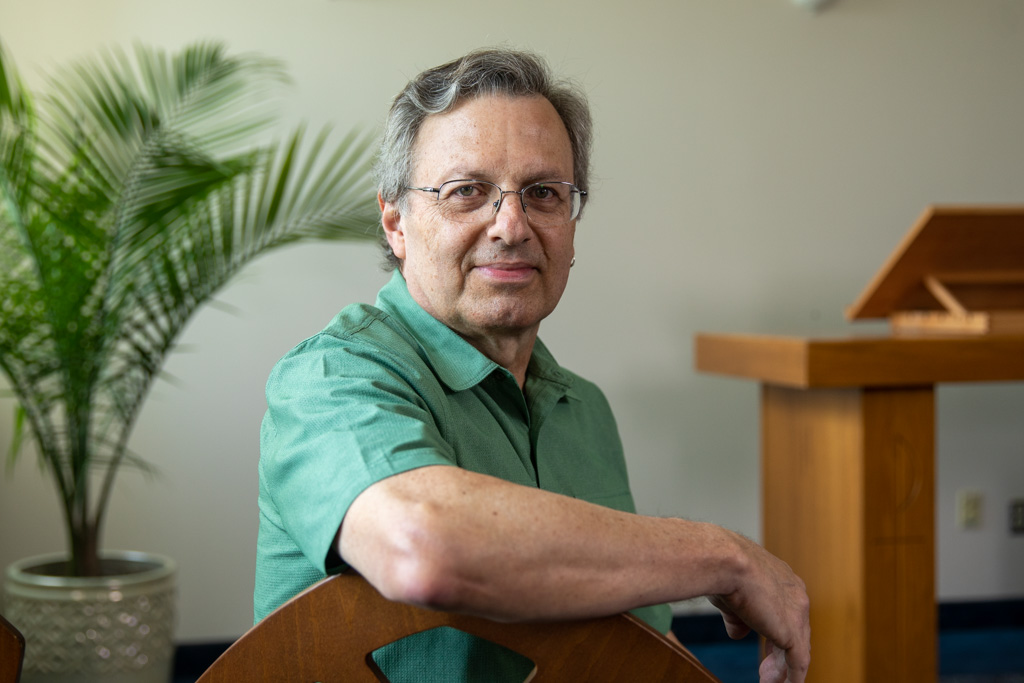
A guest post by Doctor of Ministry student, Nathan Sanders:
In recent years I have started to recognize that modern Protestantism has largely reduced "evangelism" to a narrow aim of winning converts to the faith. But even as those of us in Christian leadership go about the necessary task of re-evaluating the fuller aim of what it means to "evangelize" people, we run the risk of overcomplicating, and possibly even losing hold of, one of the clearest ministry callings from our Savior to bring people to him. [1] Most of us acknowledge that we are to be involved at some level in compelling people, under the convicting power of the Holy Spirit, to become followers for Christ. [2] How quickly we forget the alternative for those who do not believe! [3] We must endeavor to retain a burning passion to encourage people out from the kingdom of darkness. Most churches are looking to large-scale events (like festivals, concerts, "revivals," etc.) to accomplish this task. This can be a big mistake! The evangelistic mission of the church is best accomplished by believers who are not on the stage, through something often called "Friendship Evangelism" (FE). This method of fulfilling Christian mission is far less expensive, more holistic, and much more fun than traditional approaches to bringing people into the faith. In part II of "Don't Lose the Mission Behind Missional" I will share insights on why FE is often forgotten in churches, as well as practical ways to implement it in everyday life.
Nathan Sanders has been involved in Christian leadership and ministry since 1993 and has served as a university campus evangelism leader, inner-city ministry coordinator, conference speaker, associate pastor, and nearly 8 years as a senior pastor. He is presently teaching New Testament Literature at Elim Bible Institute in Lima, NY. He earned a Ministry Diploma from Elim Bible Institute in 1996, a Master of Arts in Practical Theology from Regent University in 2001, and is currently beginning work toward a Doctor of Ministry degree from Northeastern Seminary. Click here to find Nathan on Facebook.
[1] Matthew 28:18-20 Then Jesus came to them and said, "All authority in heaven and on earth has been given to me. Therefore go and make disciples of all nations, baptizing them in the name of the Father and of the Son and of the Holy Spirit, and teaching them to obey everything I have commanded you. And surely I am with you always, to the very end of the age.
[2] Acts 16:30-32 He then brought them out and asked, "Sirs, what must I do to be saved?" They replied, "Believe in the Lord Jesus, and you will be saved—you and your household." Then they spoke the word of the Lord to him and to all the others in his house.
[3] John 5:28-29 Do not be amazed at this, for a time is coming when all who are in their graves will hear his voice and come out—those who have done what is good will rise to live, and those who have done what is evil will rise to be condemned.
Revelation 20:15 Anyone whose name was not found written in the book of life was thrown into the lake of fire.
A guest post by NES alumna, Marlena Graves
Over and over while at Northeastern Seminary I asked God, “What do you want me to do with this treasure trove of life-giving information?” In essence the question was, “How can I live and hand down the great tradition I’ve received?” Little did I know that two years after graduation I’d be writing for Christianity Today while living as a resident director on a Christian college campus with my family—embodying what I learned.
At NES, we were immersed in Scripture while learning church history and practical/pastoral theology. Added to the mix were biblical languages, philosophy, and the nuts and bolts of the best practices in the art of pastoring and pastoral care. We learned while reading primary resources, through our internships, and in the classroom—all while being spiritually formed.
In our spiritual formation groups, we shared our lives including our personal/church triumphs and struggles while trying to figure out just exactly how to individually and communally apply what we learned. Through it all, I saw how God moved within different cultural contexts during each historical time period (including our own by listening to my classmates’ stories). The Christians leaders that I learned about were culturally engaged and culturally literate—even if they were obscure. Although imperfect like all of us, they brought and incarnated the word of God for their time.
What is cultural literacy? Janice Campbell offers this definition: “To be culturally literate is to understand the history and concepts that underlie a culture, and to be able to converse fluently in the allusions and informal content of that culture.” NES taught me biblical and cultural literacy. They educated me well in the history and teaching of Christianity since its inception—since Jesus was born. And so NES taught me how to bring and incarnate the word of God for our time. Now, whether I am writing an article about racial diversity, school shootings, marital relationships, male/female roles in the church, or writing a sermon, or on campus or at home or church, I bring to bear what I learned at NES.
If I am culturally and biblically literate and full of the Holy Spirit and staying right at Jesus’s heels like the faithful throughout time, then I will be able to apply God’s truth to my immediate and broader culture. Like those in Scripture and throughout church history, it is crucial that I understand the language and events of our culture and then be able to translate God’s life into it. Otherwise, I’ll be less effective and productive in my knowledge of God.

Marlena is a 2007 graduate of NES. She is a regular writer for Christianity Today’s Her.meneutics blog. Her work has appeared in various other venues, such as the Clergy Journal. Currently, she is working on two manuscripts she hopes will see the light of day. In addition, she regularly speaks to college students and congregations about spiritual formation. She is married to the love of her life, Shawn Graves, a philosophy professor. Together, they have a four-year-old gregarious and precocious daughter, Iliana. You can find Marlena’s personal blog at: http://hispaththroughthewildnerness.blogspot.com.
A guest post from Dr. Paul Livermore, professor of biblical and systematic theology
One remarkable irony of history concerns the day Abraham Lincoln was shot: Good Friday, 1865. As word trickled throughout the country, people stayed close to telegraph machines to hear the latest. When the announcement of his death was finally made, the national grief was deep.
Carl Sandburg records some remarkable reactions to the tragedy. One took place in Boston on Saturday morning after the President was gone. Men began to march on the Common in a spontaneous parade-like form. The few became many, more than a thousand. They said nothing, they did nothing but marched.
Some people—but only a very few—are so noble, so good, so powerful in their influence that we cannot help but honor their greatness. Such a person was Abraham Lincoln.
Such a person in an even greater degree was Jesus of Nazareth.
When officials urged Jesus to silence the crowds that celebrated him with palm branches, he responded, “I tell you, if these were silent, the stones would shout out” (Luke 19:40, NRSV). What was it about Jesus of Nazareth that evokes such powerful emotion?
He arose from among the common people, hard-working peasants who lived unpretentious lives.
He lived a life of personal integrity. There were no dark sides to him, nothing to hide or make excuses for. He was exactly what he appeared to be.
He loved ordinary people. He was even a friend of “tax collectors and sinners.” A simple meal with the stingy Zacchaeus, turned him around into a generous person. He also had his own close friends he enjoyed eating with, like Mary and Martha and their brother Lazarus. His way with children was authentic, not contrived or staged, and they loved him for it.
He challenged the status quo and institutionalized system, when it brought injustice and shut innocent people out. He did this at great personal risk, ultimately paying for it with his own life by a cruel and humiliating death.
But Jesus rose above bitterness. He not only said we should turn the other cheek; he did that. He prayed for those who thought of him as an enemy, even when they were abusing him.
He had a profound relationship with God. He went out into the country early in the morning to pray. He taught that this relationship with God gave him the inner resources to be kind of person he was.
Christians rightly acknowledge him as the Son of God. Palm Sunday is the right time to celebrate him as the noblest person who ever lived. The historic church has taught that if we would be authentic Christians, we should “imitate Christ.”

Dr. Paul Livermore
Professor of Biblical and Systematic Theology
Northeastern Seminary
Rochester, NY
This piece was also published in the Palm Sunday edition of the Rochester Democrat and Chronicle.
A post by guest blogger, Glen Dornsife, M.Div. student at Northeastern Seminary.
Having the opportunity to be a student at Northeastern Seminary has offered me the chance to involve myself in something I would otherwise have not known about—the Lectionary. If you are not familiar with what this is, it is a formulated list assigning scripture to certain days or weeks throughout the year. It may be a mere coincidence, but when I actually follow the assigned scriptures I find myself immersed in a divine rhythm. Recently, I’ve begun to wonder if my professors have intentionally assigned my readings and school work to coincide with the lectionary. I am not saying that if you start reading the lectionary tomorrow you will have the same “results,” but maybe if you register to be a student at NES while reading it simultaneously you will!
“I Do!”
In Exodus we read about how God shows off His love by delivering the Israelites from Pharaoh. The Red Sea moment is God basically saying, “I am going to be your God from here on out.” “I want the whole world to know that you are mine, and I am yours.” God’s exodus moment with them is similar (I think) to when a couple drops 20K on their wedding just to share their vows with each other. After the Israelites take a big leap of faith into the water, they spend their honeymoon on the romantic eastern beaches of the Red Sea. They stayed there for awhile in the afterglow of knowing that their God was a miracle-working provider. Later, they would declare He was their YHWH-Nissi, “The Lord is my Banner!” Israel’s deliverance echoes throughout history God shouting the words, “I Do!”
“I Do…Not!”
Relational disharmony is often caused by lack of trust. Distrust brings us to the point where we no longer desire to move forward in our relationship. It is hard to imagine not wanting to move forward with God after such an amazing beginning, but this happens in our journey more often than most would like to admit. The moments of distrust usually arise from something little that causes us to question the other person. This is where we will pick up the Israelites Exodus story.
You see a few chapters later the people begin to grow weary and tired of their God-sized relationship. Their basic needs weren’t being met! They were thirsty. As a result, they began complaining to Moses that he and God were leading them right to their death. They had forgotten that a few days ago God spent 20K on their deliverance ceremony just to let them know He loved them.
“I Do!”
This morning I noticed even in the very old Old Testament God has always been saying to His people, “I Do!” Our faith journey, much like the Israelites, is a difficult one that requires our hearts to be set on a pilgrimage. The circumstances of life often take us through fertile and dry lands and we must remember that even though our circumstantial feelings may contradict the faithful love of God, YHWH is for us! The Lord is your Banner! His love, provision, grace, and mercy were certain then, and will always be, under the victory banner we have in Christ.
To read a bit more about the Israelite’s story you can find it in Exodus 17 and Psalm 95, which is found in the Lectionary under the “Third Sunday in Lent.” To be immersed in the “I Do’s” of God’s love, seriously consider becoming a student at Northeastern Seminary.
Receive more information about Northeastern Seminary.

Glen Dornsife, M.Div. student
Northeastern Seminary
A post by guest blogger, Barbara Bushart, MDIV, MSW, adjunct professor at Northeastern Seminary.
A 2007 study funded by the National Organization on Disability reported that 54 million Americans live with a significant and permanent disability.[1] In light of that statistic, churches must be prepared to minister to individuals with disabilities and their families with sensitivity and a biblical vision of hospitality which welcomes all people. One mother of a child with autism related that she was tired of churches turning her and her son away by saying they were not “equipped” for her son’s special needs.[2] What must we do to become better “equipped” to welcome those living with disabilities? Some suggestions follow for those wishing to begin or strengthen existing disability ministries:
1) Express an openness to address accessibility issues. Invite dialogue when individuals or families encounter barriers to their full participation in the life of the local congregation. Be sure that all print and electronic media utilized by your community of faith have statements that welcome people to share their needs in this regard.
2) Involve individuals and families in decisions about what accommodations work well for their circumstances. Many common and erroneous assumptions exist about various disabilities. For example: Not all blind individuals have learned to read Brailled materials and many people with profound hearing loss do not use sign language to communicate. Good intentions based on wrong information will not yield a positive outcome. Ask, listen, and proceed together toward a solution for the accessibility need represented.
3) Do not assume that most accommodations are cost-prohibitive. Often creativity and willingness are more necessary components to eliminate barriers than funds.
4) Do not become discouraged or impatient if the solution requires multiple attempts before it is solved. Every setting and situation is unique and the person with the disability may not have an immediate answer to what will work without some experimentation. The process itself can be an opportunity to give and receive grace if approached with open minds and hearts.
Barbara Isaman-Bushart, MDIV, MSW, Adjunct professor,
Disability Awareness for Christian Ministers and Laypersons
Northeastern Seminary
Learn more about Disability Awareness class offered April 9 – May 7, 2012.
[1] National Organization on Disability, accessed October 15, 2009, http://nod.org.
[2] Preliminary research indicates that the “unchurched” rate of families where a child has a disability is between 90 and 95% as cited by Jessica James Baldridge, “Church Based Disability Ministries” in Why O God? Suffering and Disability in the Bible and the Church, ed. Larry J. Waters and Roy B. Zuck (Wheaton, IL: Crossway Publishing, 2011), 40.
Read Part One here.
Read Part Two here.
Northeastern Seminary is committed to the personal and spiritual growth of every seminarian. Through the innovative and integrative Personal and Spiritual Formation curriculum, students are exposed to the rich resources and disciplines of formative Christian spirituality. We affirm that the indispensable foundation for Christian ministry is a vital relationship with God through Christ, and so we seek to provide a nurturing community in which genuine Christian faith can deepen and thrive.
So how did it turn out for the apprehensive student journeying through faith sharing?
“Thanks to our facilitator who was patient and accepting, and the blessing of God, we learned to let our guard down. We felt more at ease with each other and most importantly with ourselves. We shared deeper and more intimate parts of ourselves, as with the grace and love of God, our nervousness was replaced with understanding, trust, and care for one another. Personally, I started looking forward to faith sharing because I was able to learn not only new things about myself, but I also started to examine in a new light some old beliefs, patterns and behaviors. I could see a change in group members who were also sharing more intimately as a safe environment and certain confidentiality had been established. The work in ourselves had begun under the guidance and direction of God.”
Click here if you would like to learn more about the Spiritual Formation curriculum at Northeastern Seminary.
A post by guest blogger, Todd Daningburg, adjunct professor at Northeastern Seminary.
Churches face the difficult, but not impossible, task of nurturing and developing people at all levels of spiritual maturity. Congregations likely include new Christians, others with more experience and training in following Christ, and still others who have lived long and committed lives of faith. Hopefully, there are also people who would not yet identify themselves as Christians, but who are present to learn from Christ-followers, encounter God’s truth, and discover God’s grace.
Based on Ephesians 4:11-13, an equipping model of ministry enables a local church to successfully foster the spiritual growth of all its members regardless of their starting point.
PREPARE AND EMPOWER OTHERS
The primary task of pastoral leadership is to equip people for ministry. Rather than do the entire ministry, this frees the clergy to encourage and facilitate the ministry of others. When one person tries to meet the needs of 100 people, the task can be overwhelming. However, if a pastor equips 10 others to share in ministry, his or her capabilities and effectiveness are multiplied exponentially.
KINDLE GIFTEDNESS AND CALLING
Every Christian is called and gifted for some type of ministry. Romans 12 and I Corinthians 12 are two passages indicating that every member of Christ’s body has a ministry. The fact that the Holy Spirit was poured out on all believers gathered at Pentecost (Acts 2) verifies that every Christian has been provided the necessary resources to help carry out the mission of God in the world.
ADVOCATE AND DEMONSTRATE “THE PRIESTHOOD OF ALL BELIEVERS”
The culture of the local church encourages everyone’s ministry potential. Rather than having a “dependency” model, in which the pastors “do ministry” and everyone else is a passive recipient, the mindset that “every member is a minister and every member has a ministry” is promoted and celebrated. People move from being consumers of ministry to becoming active participants in ministry. Pastors develop the perspective and habit of “giving ministry away.”
CREATE A FRAMEWORK
Systems that help people understand and use their spiritual gifts are developed and implemented. People are encouraged to experience ministry first-hand with opportunities for reflection and evaluation.
Ministry leaders are among the spiritual outfitters who prepare others to serve. In the church, with the right outfitting for ministry, spiritual hunger can be satisfied and lives nurtured toward maturity in Christ. How do you encourage the spiritual growth among the variety of people who are all at different places in their spiritual journey?
Todd Daningburg
Adjunct Professor
Northeastern Seminary
Todd Daningburg will be teaching Equipping the Laity on Monday evenings from February 27-March 26, 2012. Information about auditing this class can be found here.
A post by guest blogger, Barbara Bushart, MDIV, MSW, adjunct professor at Northeastern Seminary.

Between the ages of twenty-three and thirty I lost my hearing due to a genetic condition inherited from my maternal grandmother. I began to notice that the world is frequently inaccessible and sadder still, that Christian churches and ministries also are often ill equipped to offer genuine hospitality and inclusion to those living with diverse disabilities. Conversations with many people over the years have provided some common unhelpful approaches as well as a recommendation for incorporating people with disabilities into the full life of the Church:
The Overly- Enthusiastic Healing Approach
In this scenario, the person with a disability is viewed as an “opportunity” to display the power of God to the world by a healing event. Conversely, an absence of healing may be interpreted as evidence of unrepentant sin or a shameful lack of faith. The person with a disability may be judged as spiritually unfit in some regard and blamed for the persistent physical condition where healing appears to fail.
The Sainthood Approach
Here, people with disabilities are held up as examples of God’s special favor, chosen to suffer as Christ suffered and to demonstrate God’s strength through weakness. Living on a pedestal is nearly as difficult as living under judgment; in both cases the categorizations create obstacles to true fellowship and mutuality.
The “Many Members: One Body” Approach
Thankfully, many churches and fellowships are recognizing that individuals with disabilities are not objects to either cure or venerate, but simply people: people to be fully enveloped into the life of the Church, people who offer unique gifts and perspectives, people who complement other members and complete the Body of Christ. This approach requires an openness to listen to people with disabilities and to learn from them how to improve accessibility and create a church experience where the gifts of all God’s people are respected.
Barbara Bushart, MDIV, MSW, Adjunct professor,
Disability Awareness for Christian Ministers and Laypersons
Northeastern Seminary
Watch for helpful suggestions in part 2, learn more about the Disability Awareness class offered April 9 – May 7, 2012.

Visions of surfing in between theology classes in California or studying in the historic hallways of Boston architecture dance in the heads of many aspiring seminarians. For some, seminary is an extension of their wonderful undergraduate years and for others it is the prestige of studying at North America’s finest. Below are several compelling reasons why one should consider pursuing seminary in upstate New York.
1. Content is as abundant as the stars. You can find more books on ministry and theology than you could read in a lifetime. Contextual ministry, however, is the name of the game. Your location has unique challenges and pressures that may not be addressed in an Orlando, Florida seminary option. Going to a regional seminary that is attune to local upstate New York ministry challenges affords you the benefit of having the most prevalent issues regularly addressed during your degree.
2. Going to a regional seminary is a fraction of the cost of relocating out of state. Oftentimes, regional seminaries have flexible scheduling and locations that allow students to maintain their employment and residence while going to school (or earning a degree) at the same time.
3. For most seminaries, a supervised practicum (or field education) is critical to a student’s experience. Regional seminaries are positioned to place students so they can complete their field education in their current place of ministry if they wish to. And when that placement includes an intentional and effective oversight as a well developed goal setting process, all the better.
A post by guest blogger, Todd Daningburg, adjunct professor at Northeastern Seminary.
On a recent flight back to Rochester, N.Y. from Los Angeles, in seat 45K—the window seat in the last row, the person in seat 45J was very nervous about the flight. At one point, she intended to get off the plane before we left the gate because the co-pilot was running late and she took that as a bad sign. With a five-hour flight and little to do to fill the time, besides watching the movie, "Cowboys vs. Aliens," we chatted about our lives. When she found out I was a pastor, she breathed a huge sigh of relief. She thought that might reduce the likelihood that we would have catastrophic problems with our flight.
Clearly, she elevated a person in ministry to a "higher plane" (pun intended) than other "ordinary" lay people. Somehow, she believed that my vocation put me in a privileged and protected relationship with the Almighty, which she would benefit from (along with all 245 people on board) because she was sitting next to me.
I share this to point out a common, but incorrect assumption, that clergy are somehow "closer to God" than other people, and that lay people do not carry the same weight when it comes to interacting with God. Such thinking fosters the notion that pastors are special and privileged when it comes to things divine and that lay people are not as capable of hearing from and serving God. The reality is, we all, clergy and laity alike, have "equal access" to God through Jesus Christ. We are all called to follow and serve Him. The Holy Spirit is given to all who accept Him as Savior and Lord. Understanding, proclaiming, and implementing the principle of the "priesthood of all believers" in the Church will foster greater fulfillment of God's Kingdom mission in the world today.
How might you harbor misconceptions about the roles of clergy and laity and their relationship to God?
Todd Daningburg
Adjunct professor
Northeastern Seminary
Learn more about enrolling in the Equipping the Laity class offered February 27 – March 26, 2012.